
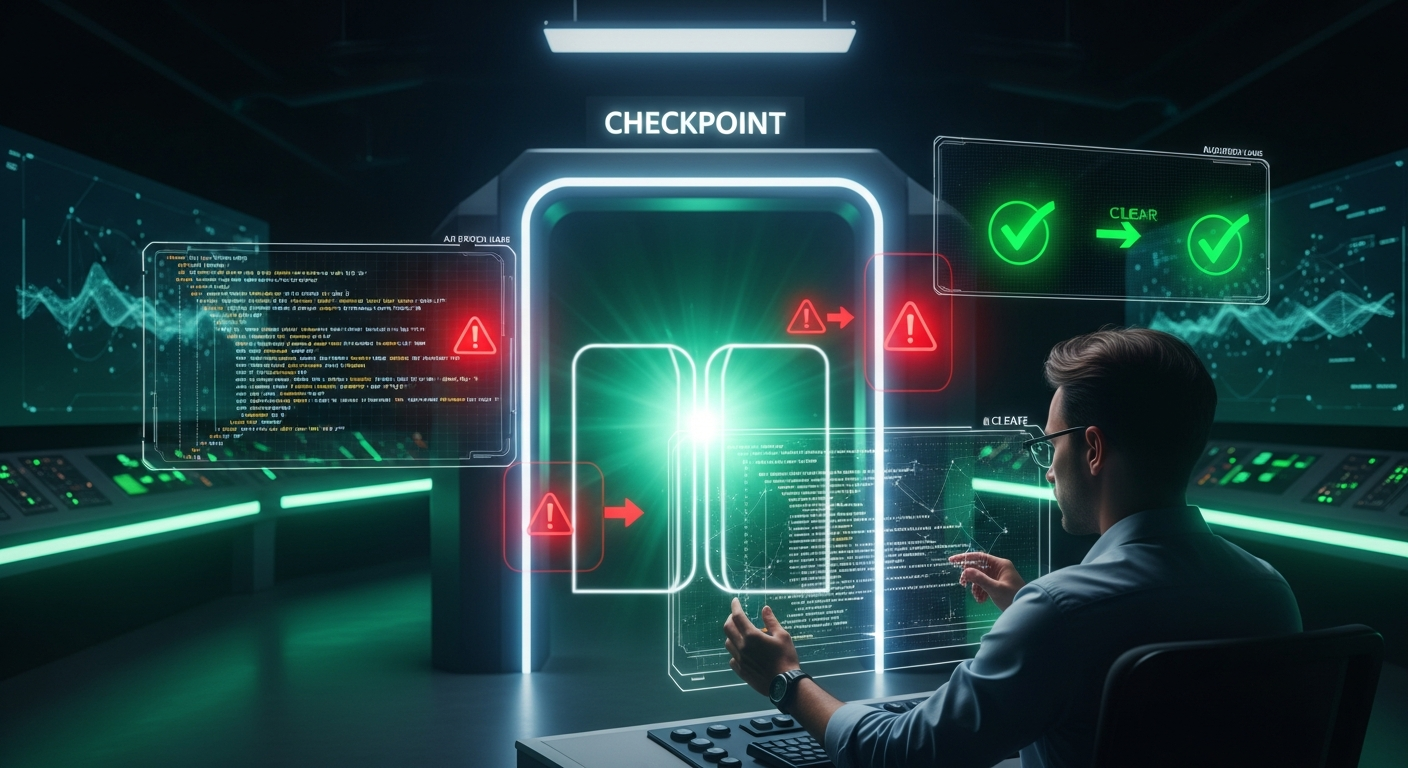
The Amazon Wake-Up Call: What Actually Happened
In early 2026, Amazon's engineering teams were aggressively piloting Kiro AI — an agentic coding assistant that could autonomously generate, review, and deploy infrastructure changes. The productivity gains looked remarkable on paper: 40% faster sprint velocity, 60% reduction in toil for routine configuration tasks.
Then came the outage.
A Kiro AI agent, while optimizing an IAM policy for a microservice, inadvertently modified a shared permission boundary that cascaded across 47 dependent services. The change passed automated tests (the blast radius was invisible to unit tests). It passed linting. It even passed a lightweight security scan. What it didn't pass was a senior engineer's eye — because there was no requirement for one.
The result: a 13-hour production outage affecting multiple AWS regions, impacting downstream customers, and costing Amazon an estimated $35M in SLA credits and engineering recovery time.
Amazon's immediate response: a new engineering mandate. Every AI-generated change to infrastructure, shared configuration, IAM, or production-facing services now requires explicit senior engineer sign-off before merge.
The industry took notice. Within weeks, similar policies appeared internally at Google, Microsoft Azure, and several tier-1 banks in the US and EU. The era of casual AI-assisted DevOps was over. The era of governed AI DevOps had begun.
I've spent 25 years building and operating production systems at JPMorgan, Deutsche Bank, and Morgan Stanley. Every major outage I've seen — including the ones from before AI was in the picture — came down to the same root cause: a change that bypassed the human judgment layer. AI just makes the blast radius bigger and the feedback loops faster. The fix is the same as it's always been: structured gates, clear ownership, and machine-speed rollback.
Let me show you exactly how to build those gates.
Why "Just Ban AI from Production" Is the Wrong Answer
The knee-jerk reaction to the Amazon incident among many enterprise CTOs was predictable: freeze all AI-assisted deployment tooling, pending a full security review. I understand the instinct. When something breaks at that scale, you want to turn off the moving part.
But banning AI from your DevOps pipeline is like banning power tools after a construction accident. The tools aren't the problem. The absence of safety protocols is.
Consider what you lose with a blanket ban:
- Velocity advantage: Engineering teams using AI-assisted CI/CD are currently shipping features 2–4× faster than those that aren't. Your competitors won't be banning AI.
- Toil reduction: AI agents handle the repetitive configuration, dependency updates, test generation, and documentation tasks that eat 30–40% of senior engineer time.
- Cognitive offload: AI review catches an estimated 23% of security misconfigurations that human reviewers miss at high velocity (Gartner, 2026).
The Amazon outage wasn't a failure of AI capability. It was a failure of AI governance. The agent was doing exactly what it was asked to do — optimize a permission policy — but no one had defined the boundary of what "optimize" meant in the context of shared infrastructure.
The answer isn't less AI. It's smarter governance.
Teams that implement structured AI governance — tiered trust levels, clear scope boundaries, and human-in-the-loop gates for high-risk changes — are, counterintuitively, deploying AI-assisted changes faster than teams with ad-hoc or no governance. Why? Because trust is the accelerator. When engineers trust the guardrails, they approve fast. When they don't trust them, every change becomes a crisis.
The 5-Checkpoint AI DevOps Governance Framework
This is the framework I've been building with enterprise clients since late 2025. It maps directly onto any modern CI/CD stack (GitHub Actions, GitLab CI, ArgoCD, Tekton) and can be implemented incrementally — you don't need to rebuild your pipeline from scratch.
Checkpoint 1: Change Risk Scoring
Every AI-proposed change must be scored for blast radius before it touches your pipeline. Risk scoring is the foundation — without it, your human gates will be overwhelmed with false positives or blindsided by real ones.
Here is a practical 4-tier risk matrix:
| Tier | Change Type | Examples | Required Approval |
|---|---|---|---|
| LOW | Unit tests, docs, linting, non-prod config | README updates, test file generation, dev env vars | None — fully autonomous |
| MEDIUM | Application code, staging deployments, dependency updates | npm package upgrades, feature branches, staging k8s manifests | Automated review gates (SAST, DAST, SCA) |
| HIGH | Production deployments, shared config, IAM, network policies | Terraform prod changes, K8s NetworkPolicy, RBAC, secrets rotation | Senior engineer + team lead approval required |
| CRITICAL | Core infrastructure, cross-service dependencies, billing, auth | AWS account-level IAM, database schema migrations, CA cert rotation | CTO + security team + CAB sign-off |
Automate the scoring with a simple OPA (Open Policy Agent) policy that reads your change diff and labels it before the pipeline proceeds.
Checkpoint 2: Scope Boundary Enforcement
Before an AI agent can propose a change, you must define what it is and isn't allowed to touch. Think of it as a blast radius budget. Here's an OPA Rego policy that enforces scope for AI-generated Terraform plans:
package ai_devops.scope

# Deny AI agents from modifying IAM resources
deny[msg] {
    input.change_source == "ai_agent"
    resource := input.planned_values.root_module.resources[_]
    startswith(resource.type, "aws_iam_")
    msg := sprintf("AI agent change blocked: IAM resource '%v' requires human review", [resource.address])
}

# Deny AI agents from modifying shared VPC/networking
deny[msg] {
    input.change_source == "ai_agent"
    resource := input.planned_values.root_module.resources[_]
    resource.type == "aws_vpc"
    msg := "AI agent change blocked: VPC modifications require human review"
}

# Deny cross-namespace K8s changes from AI agents
deny[msg] {
    input.change_source == "ai_agent"
    resource := input.planned_values.root_module.resources[_]
    resource.type == "kubernetes_namespace"
    msg := "AI agent change blocked: Namespace creation requires human review"
}

# Allow everything else (application workloads, configmaps, services)
allow {
    count(deny) == 0
}
Checkpoint 3: Human-in-the-Loop Gates
For HIGH and CRITICAL tier changes, you need a hard approval gate in your pipeline. Here is a GitHub Actions workflow step that pauses the pipeline and pings the required reviewer via Slack:
- name: AI Governance Gate
  id: governance_gate
  uses: trstringer/manual-approval@v1
  timeout-minutes: 60
  with:
    secret: ${{ github.TOKEN }}
    approvers: senior-engineers,platform-team
    minimum-approvals: 1
    issue-title: "🤖 AI Change Approval Required: ${{ github.event.head_commit.message }}"
    issue-body: |
      **AI-generated change requires human approval before deployment.**

      **Risk Tier**: ${{ steps.risk_score.outputs.tier }}
      **Changed Resources**: ${{ steps.risk_score.outputs.resources }}
      **AI Agent**: ${{ steps.risk_score.outputs.agent_id }}
      **Blast Radius Score**: ${{ steps.risk_score.outputs.blast_radius }}/100

      Review the diff carefully. Approve by commenting: `/approve`
      Block by commenting: `/deny reason: [your reason]`
    exclude-workflow-initiator-as-approver: false
Pair this with a PagerDuty alert for CRITICAL changes so the on-call engineer is notified even outside business hours.
Checkpoint 4: Canary + Staged Rollout
Even after human approval, AI-generated changes should enter production gradually. A 1%–5%–20%–50%–100% canary progression with automated health checks at each stage catches issues before they become outages.
For Kubernetes deployments, use Argo Rollouts with an analysis template that checks error rate and latency automatically:
apiVersion: argoproj.io/v1alpha1
kind: Rollout
metadata:
  name: ai-generated-deployment
  annotations:
    ai-governance/change-source: "ai_agent"
    ai-governance/risk-tier: "high"
    ai-governance/approver: "rajesh.gheware"
spec:
  replicas: 10
  strategy:
    canary:
      steps:
      - setWeight: 5         # 5% canary
      - analysis:
          templates:
          - templateName: ai-change-health-check
      - pause: {duration: 5m}
      - setWeight: 20        # Scale to 20%
      - analysis:
          templates:
          - templateName: ai-change-health-check
      - pause: {duration: 10m}
      - setWeight: 100       # Full rollout
---
apiVersion: argoproj.io/v1alpha1
kind: AnalysisTemplate
metadata:
  name: ai-change-health-check
spec:
  metrics:
  - name: error-rate
    provider:
      prometheus:
        address: http://prometheus:9090
        query: |
          sum(rate(http_requests_total{status=~"5.."}[5m]))
          /
          sum(rate(http_requests_total[5m]))
    successCondition: result[0] < 0.02   # Block if >2% error rate
    failureLimit: 1
  - name: p99-latency
    provider:
      prometheus:
        address: http://prometheus:9090
        query: histogram_quantile(0.99, rate(http_request_duration_seconds_bucket[5m]))
    successCondition: result[0] < 1.5    # Block if p99 > 1.5s
Checkpoint 5: Automated Rollback with Full Audit Trail
When (not if) something goes wrong, you need machine-speed rollback and a complete audit trail that answers: what changed, what AI agent proposed it, who approved it, and what the blast radius was.
Every AI-generated commit should include a structured governance metadata block in its commit message:
feat(infra): update K8s resource limits for payment-service

[AI-GOVERNANCE]
change_source: kiro-ai-agent-v2.1
risk_tier: high
blast_radius: 34/100
approved_by: rjain@company.com
approved_at: 2026-03-11T04:22:31Z
rollback_commit: abc123def
scope_policy_version: v1.4.2
opa_evaluation: PASS
[/AI-GOVERNANCE]
When Argo Rollouts detects a canary failure, it will automatically roll back to the previous revision. Your incident response runbook should then query the audit trail from this governance metadata to reconstruct the full chain of custody within minutes.
Implementation Guide: Wiring Governance into Your CI/CD Pipeline
Here is a practical 2-week implementation plan for a team with an existing GitHub Actions + ArgoCD stack:
Week 1: Foundation
Day 1–2: Risk Scoring Script
Write a Python or Go script that analyzes your git diff and classifies changes into LOW/MEDIUM/HIGH/CRITICAL based on the file paths and resource types touched. Add it as a GitHub Actions job that runs on every PR from an AI agent branch.
Day 3–4: OPA Scope Policy
Deploy OPA as a sidecar or GitHub Actions step. Write policies that deny AI agents from touching IAM, network, and shared infrastructure resources. Start permissive — only block on CRITICAL resources — and tighten over the next sprint based on what you observe.
Day 5: Commit Metadata Standard
Define the governance metadata block format and enforce it via a commit-msg Git hook on AI agent workflows. This takes one afternoon but is the most important audit investment you'll make.
Week 2: Gates and Observability
Day 6–7: Human Approval Gate
Wire the manual approval action for HIGH and CRITICAL changes. Configure Slack notifications. Do a dry run with a non-production change to verify the workflow. Brief your senior engineers on the new expectation: they are the last line of defense, not a rubber stamp.
Day 8–9: Argo Rollouts Canary
Convert your top 3 most critical services to Argo Rollouts with the analysis template from Checkpoint 4. These are almost certainly the services that an AI-generated change could take down most catastrophically.
Day 10: Dashboard and Runbook
Build a Grafana dashboard showing: AI change volume by tier, approval times, rollback rate, and mean time to approval. Update your incident runbook to include AI governance metadata retrieval steps. Share both with the CTO.
What "Done" Looks Like
After 2 weeks, your AI governance posture should be:
- 100% of AI-generated changes classified by risk tier before merging
- 0% of HIGH/CRITICAL AI changes reaching production without human sign-off
- Canary rollout on all production deployments (AI-generated or not)
- Full audit trail queryable in under 5 minutes post-incident
- Mean time to rollback < 3 minutes (Argo automated)
This is exactly the posture Amazon is now enforcing. The difference is you're implementing it proactively — before the 13-hour outage, not after.
Agentic Engineering Maturity: Where Does Your Team Stand?
Most enterprise engineering teams sit at one of four levels of agentic AI maturity. Understanding where you are helps you prioritize governance investments.
Level 1: AI-Assisted (Ad Hoc)
Engineers use GitHub Copilot, Cursor, or ChatGPT for code suggestions, but there is no structured process for AI-generated changes. No labeling, no scope boundaries, no approval workflow. This is where the Amazon incident happened.
Risk level: High. Fix immediately with Checkpoints 1 and 2.
Level 2: AI-Integrated (Governed)
AI agents are integrated into the CI/CD pipeline with formal risk scoring, scope policies, and human approval gates for HIGH/CRITICAL changes. Teams have a rollback runbook specific to AI-generated changes.
Risk level: Managed. This is the target state for 2026.
Level 3: AI-Native (Trusted Autonomy)
AI agents autonomously handle LOW and MEDIUM changes end-to-end, including deployment. Human gates remain for HIGH/CRITICAL but average approval time is < 15 minutes due to established trust. Teams have quantitative data on AI agent reliability by change type.
Risk level: Low with strong monitoring. Goal for mature teams by 2027.
Level 4: Autonomous Operations (AgentOps)
AI agents operate entire services within defined policy envelopes. Humans set strategy and policy; agents handle execution. Less than 5% of enterprise teams are here today. This requires Level 3 governance maturity as a prerequisite — you cannot skip ahead.
Risk level: Acceptable only with full observability, circuit breakers, and real-time human oversight tooling.
If you are below Level 2, the Amazon story is your story. The question is whether you fix it now or wait for your own production incident to force the issue.
Our enterprise training program covers the full journey from Level 1 to Level 3 — including hands-on labs where engineers build and operate an AI DevOps governance pipeline on a real Kubernetes cluster. See the curriculum →
Frequently Asked Questions
What is AI DevOps governance?
AI DevOps governance is a structured framework of policies, checkpoints, and human oversight controls that determine when AI agents can autonomously make changes to infrastructure or code, and when they require human approval. It defines trust boundaries, rollback protocols, and audit trails for AI-assisted CI/CD pipelines — ensuring velocity without sacrificing production safety.
Why did Amazon mandate senior sign-off on AI-assisted changes?
After an AI coding assistant (Kiro AI) caused a 13-hour production outage on AWS by autonomously applying changes that cascaded across 47 dependent services, Amazon updated its engineering standards to require senior engineer review and approval before any AI-generated infrastructure or configuration change is deployed to production. The incident exposed the risk of AI agents operating outside defined scope boundaries on shared infrastructure.
Is autonomous DevOps dead after the Amazon AI outage?
No — autonomous DevOps is not dead, but unguarded autonomous DevOps is. The Amazon incident proved that AI agents need structured trust boundaries, not blanket autonomy. The future is human-AI collaboration with tiered approval workflows: low-risk changes remain fully autonomous; high-risk changes to shared infrastructure require human validation gates. Teams implementing this balanced approach are shipping faster, not slower.
What are the 5 checkpoints of AI DevOps governance?
The 5 checkpoints are: (1) Change Risk Scoring — classify every AI-proposed change by blast radius; (2) Scope Boundary Enforcement — OPA policies restrict what AI agents can modify; (3) Human-in-the-Loop Gates — approval required for HIGH/CRITICAL changes; (4) Canary + Staged Rollout — validate incrementally before full deployment; (5) Automated Rollback with Audit Trail — machine-speed recovery with full chain-of-custody metadata.
How long does it take to implement AI DevOps governance?
A team with an existing GitHub Actions + ArgoCD stack can implement the core 5 checkpoints in approximately 2 weeks: Week 1 covers risk scoring, OPA scope policies, and commit metadata standards; Week 2 covers human approval gates, Argo Rollouts canary deployment, and an observability dashboard. The investment is roughly 60–80 engineer-hours and pays back on the first prevented outage.
Conclusion: Governance Is the Competitive Advantage
The Amazon/Kiro AI incident is a watershed moment for enterprise DevOps. Not because AI is dangerous — but because it exposed the governance debt that accumulated as teams rushed to adopt AI-assisted tooling without building the safety infrastructure to match.
The 5-checkpoint AI governance framework isn't a brake on your AI adoption. It's the foundation that makes aggressive AI adoption sustainable. Teams that implement it first will have the institutional trust to push AI further, faster — while their competitors are stuck managing incident reviews and stakeholder credibility damage.
Here is what I want you to take from this post and act on this week:
- Audit your current AI-assisted pipeline. Where are AI agents currently able to propose or deploy changes without human review?
- Label one HIGH-risk AI change from the last sprint. What would have happened if it had been wrong?
- Implement Checkpoint 1 (Risk Scoring) before your next sprint. Even a crude "does this touch IAM or network?" check adds material protection.
If your team needs help moving from Level 1 to Level 2 governance maturity, our 5-day Agentic AI for Enterprise workshop covers exactly this — including live labs building OPA governance policies, GitHub Actions approval gates, and ArgoCD canary rollouts on a real Kubernetes cluster. Over 4,000 engineers have gone through our programs, and we offer a zero-risk guarantee: if you don't see value, you don't pay.
Build Governed AI DevOps Pipelines — Hands-On
5-day enterprise workshop · OPA + GitHub Actions + ArgoCD labs · JPMorgan / Deutsche Bank veterans · Zero-risk guarantee
View Enterprise Training →Rajesh Gheware is the founder of Gheware Technologies and the author of Agentic AI Engineering (2026). He has delivered enterprise DevOps and AI training to engineering teams at JPMorgan, Deutsche Bank, Morgan Stanley, Oracle, and 200+ other organizations across India, the UAE, and the US over 25 years.