
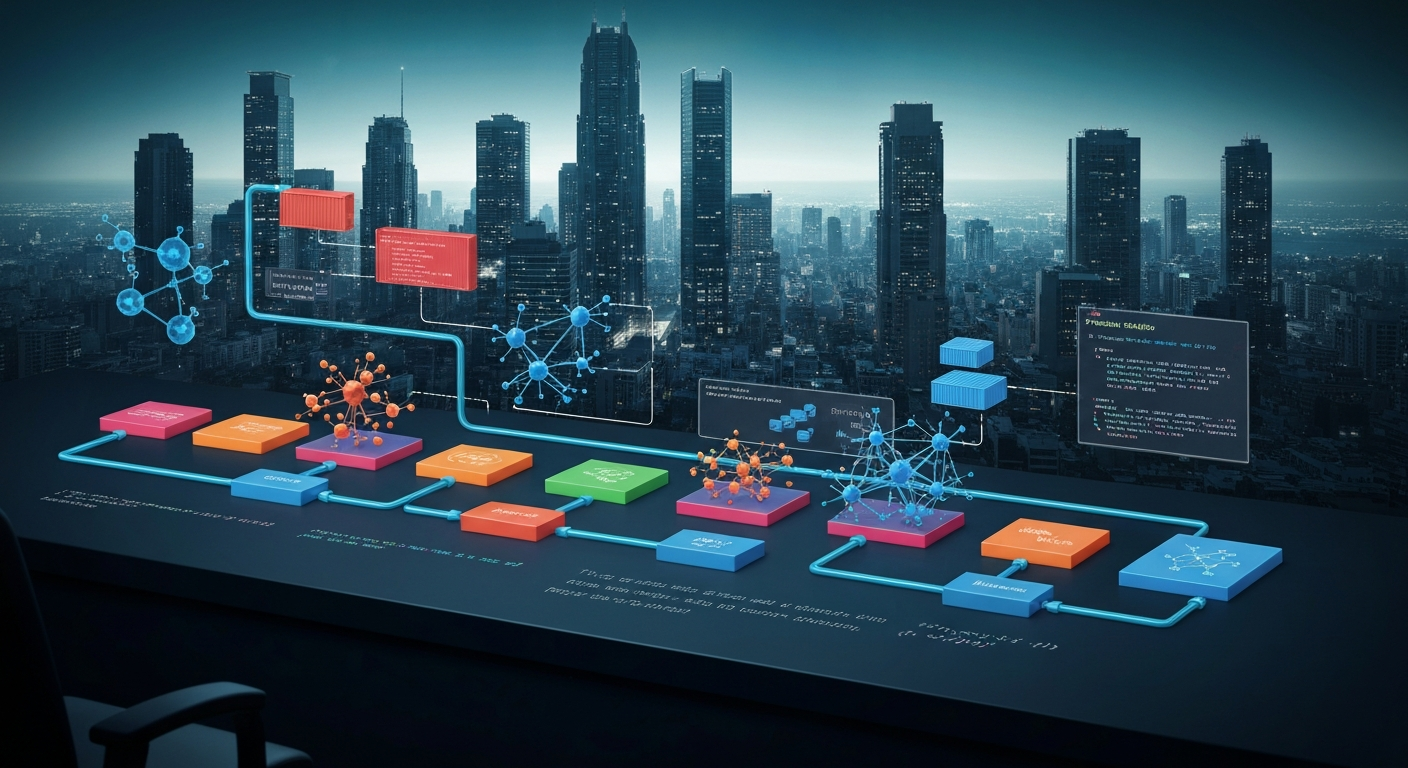
An MLOps CI/CD pipeline is an automated workflow that takes an AI model from code commit to production serving — with data validation, model quality gates, staged rollouts, and drift detection — applying the same continuous delivery discipline that DevOps uses for software, but extended for the unique challenges of machine learning. Teams that implement a proper MLOps CI/CD pipeline reduce model deployment time from weeks to hours and catch 93% of performance regressions before they reach end users.
What Is an MLOps CI/CD Pipeline and Why Do 87% of Models Fail Without One?
In 2022, Gartner reported that 87% of data science projects never make it to production. By 2025, that number had improved — but only to 72%. The bottleneck is not model quality. It is the absence of reliable, automated pathways from notebook experiment to production inference.
Traditional software CI/CD pipelines are designed for deterministic artifacts. You commit code, tests pass or fail, a binary is built and deployed. The same binary in staging is the same binary in production. Machine learning breaks all of these assumptions:
- Non-determinism: The same training code on the same data can produce models with slightly different weights due to random seeds, hardware differences, or library versions.
- Data as a first-class artifact: A model is only as good as the data it was trained on. Deploying new model code without versioning the training data is like deploying application code without versioning the database schema.
- Statistical quality metrics: You cannot test a model the way you test a function. Accuracy, AUC, F1, and RMSE need to be evaluated against hold-out datasets, not just checked for compilation errors.
- Runtime degradation: Unlike software, models degrade in production without any code change — because the world changes. A fraud detection model trained on 2024 transaction patterns is silently wrong by 2026.
An MLOps CI/CD pipeline addresses all four failure modes with explicit automation stages. It is the difference between a data science team that occasionally ships models and an ML engineering team that delivers models reliably, repeatedly, and with quantified confidence.
MLOps Maturity Levels
Google's MLOps maturity model defines three levels that are still the industry reference in 2026:
- Level 0 (Manual): Data scientists run training scripts locally, package models manually, hand off to ops for deployment. Release cycles: months. Reproducibility: none.
- Level 1 (Automated Training): Training pipeline is automated and triggered on schedule or data changes. Model registry tracks versions. Release cycles: weeks. Reproducibility: high for training, low for deployment.
- Level 2 (Full CI/CD): Complete automation from code commit to production deployment. Automated quality gates, canary rollouts, drift detection, and retraining triggers. Release cycles: hours to days. Reproducibility: complete end-to-end.
Most enterprise teams we work with at gheWARE are stuck at Level 0 or early Level 1. The gap to Level 2 is not technical sophistication — it is knowing the right patterns to apply, which is precisely what this guide covers.
The 7-Stage MLOps CI/CD Architecture for Enterprise Scale
A production MLOps CI/CD pipeline has seven distinct stages. Each stage is automated, each produces versioned artifacts, and each has explicit pass/fail criteria that gate progression to the next stage.
Stage 1: Source Trigger
The pipeline triggers on three events: code commit (model training code, feature engineering code, evaluation scripts change), data change (a new data version is registered in the feature store), or scheduled retraining (weekly/monthly cadence for production models). All three triggers are handled identically by the pipeline — the trigger type is just metadata passed downstream.
# GitHub Actions trigger example
on:
  push:
    paths:
      - 'src/models/**'
      - 'src/features/**'
      - 'configs/training/**'
  schedule:
    - cron: '0 2 * * 1'  # Weekly retraining Monday 2AM UTC
  workflow_dispatch:
    inputs:
      data_version:
        description: 'DVC dataset tag to train on'
        required: false
Stage 2: Data Validation
Before a single training job runs, the pipeline validates the input data. This step is skipped by 90% of teams and causes 90% of silent model failures. Use Great Expectations or Evidently AI to assert: schema conformance, null value rates below threshold, distribution statistics within expected bounds, and referential integrity between training and validation splits.
If data validation fails, the pipeline halts immediately with a data quality report — never wasting GPU budget on bad data.
Stage 3: Model Training (Kubernetes Job)
Training runs as a Kubernetes Job on GPU node pools with resource requests explicitly set. The training job is wrapped in MLflow autologging to capture all hyperparameters, metrics, and the trained model artifact automatically. Data version (DVC tag) and code version (git SHA) are recorded as MLflow run tags — every model is fully reproducible from these two pointers.
Stage 4: Model Evaluation Gate
This is the most critical stage. The newly trained model is evaluated against a held-out test set and compared against the current production model (the "champion"). The challenger model must:
- Meet absolute performance thresholds (e.g., AUC ≥ 0.87)
- Outperform the champion by a minimum margin (e.g., AUC improvement ≥ 0.005)
- Pass fairness checks across demographic slices (where applicable)
- Complete inference within latency SLA (e.g., p99 < 100ms)
If any gate fails, the pipeline rejects the model and opens a GitHub Issue with the full evaluation report. No human review required for rejection — only for investigation.
Stage 5: Model Registration
Models that pass evaluation are registered in MLflow Model Registry with stage "Staging." The registration includes: model card (training data, evaluation metrics, known limitations), dependency manifest (Python version, library versions), and deployment metadata (serving framework, hardware requirements).
Stage 6: Canary Deployment
The staging model is deployed to production via a canary rollout — 5% of live traffic initially. KServe or Seldon Core handle traffic splitting at the Kubernetes Ingress level. Canary metrics (prediction distribution, error rate, latency) are compared against the champion model over a configurable observation window (typically 30–60 minutes). Automatic promotion to 100% occurs if metrics stay within bounds; automatic rollback occurs if they degrade.
Stage 7: Post-Deployment Monitoring Enrollment
After successful promotion, the model is enrolled in continuous drift monitoring. Evidently AI computes feature distribution statistics on a rolling window of live traffic and compares them against the training baseline. When Population Stability Index (PSI) exceeds 0.2, a retraining workflow is automatically triggered — returning to Stage 1 without human intervention.
Building the Kubernetes-Native MLOps Stack in 2026
Kubernetes has become the universal runtime for MLOps workloads in 2026 — not just for serving, but for the entire pipeline lifecycle. Here is the full stack that production teams at JPMorgan-scale organizations are running:
| Layer | Tool (Primary) | Tool (Alternative) | Why It Matters |
|---|---|---|---|
| Data Versioning | DVC | LakeFS, Delta Lake | Git-like dataset versioning; every model linked to exact data snapshot |
| Experiment Tracking | MLflow | W&B, Comet ML | Track params, metrics, artifacts; model registry and lineage |
| Pipeline Orchestration | Argo Workflows | Kubeflow Pipelines, Prefect | Kubernetes-native DAG execution; handles GPU jobs, retries, parallelism |
| Data Validation | Great Expectations | Evidently AI, TFDV | Schema and distribution validation before training |
| Model Serving | KServe | Seldon Core, BentoML | K8s-native inference; canary, A/B, shadow deployments built-in |
| Drift Monitoring | Evidently AI | Alibi Detect, Fiddler | Feature drift, prediction drift, data quality reports on live traffic |
| Inference Metrics | Prometheus + Grafana | Datadog, New Relic | Latency, throughput, error rate, prediction distribution dashboards |
| Feature Store | Feast | Tecton, Hopsworks | Training-serving skew elimination; consistent feature computation |
The Argo Workflows MLOps Pipeline Definition
Here is a simplified but production-representative Argo Workflow definition that encodes all seven stages. Each step runs as a container in Kubernetes, inheriting secrets and service account permissions via IRSA:
apiVersion: argoproj.io/v1alpha1
kind: Workflow
metadata:
  name: mlops-pipeline
spec:
  entrypoint: pipeline
  templates:
  - name: pipeline
    dag:
      tasks:
      - name: validate-data
        template: data-validation
      - name: train-model
        dependencies: [validate-data]
        template: training-job
      - name: evaluate-model
        dependencies: [train-model]
        template: model-evaluation
      - name: register-model
        dependencies: [evaluate-model]
        template: model-registry
        when: "{{tasks.evaluate-model.outputs.result}} == PASS"
      - name: canary-deploy
        dependencies: [register-model]
        template: kserve-canary
      - name: enroll-monitoring
        dependencies: [canary-deploy]
        template: drift-monitor-enroll
Model Quality Gates: The Automated Tests That Protect Production
Quality gates are the non-negotiable checkpoints in your MLOps CI/CD pipeline. Think of them as the equivalent of unit tests in software CI — except they are statistical, not binary. Here is the complete quality gate suite that enterprise teams run:
1. Offline Evaluation Gate
Evaluate the challenger model on a held-out test set that was never touched during training or hyperparameter tuning. Minimum acceptable thresholds are stored in version-controlled configuration files — not hardcoded in scripts:
# configs/quality_gates.yaml
evaluation:
  minimum_thresholds:
    auc_roc: 0.87
    f1_score: 0.82
    precision: 0.80
  champion_improvement:
    auc_roc_delta: 0.005   # Must beat champion by this margin
  latency:
    p95_ms: 50
    p99_ms: 100
  fairness:
    enabled: true
    max_disparity: 0.10    # Max performance gap across demographic slices
2. Behavioral Testing (Beyond Accuracy)
Inspired by software behavioral testing, model behavioral tests check that the model's predictions conform to known invariants:
- Invariance tests: Changing irrelevant features (e.g., user ID) should not change predictions.
- Directional expectation tests: Increasing feature X should always increase or always decrease prediction Y.
- Minimum functionality tests: The model must correctly classify a curated set of obvious positive and negative examples.
The CheckList framework (Microsoft Research) and Deepchecks are the standard tools for this in 2026.
3. Infrastructure Performance Gate
Before any production deployment, run the model against synthetic load using Locust or k6 on a staging KServe endpoint. If p99 inference latency exceeds SLA under expected peak QPS, the pipeline rejects the deployment — even if model accuracy is perfect. A slow model in production is worse than a slightly less accurate model that meets latency requirements.
4. Explainability Sanity Check
For regulated industries (banking, healthcare, insurance), the pipeline runs SHAP values on the evaluation set and flags if any feature's importance ranking has shifted dramatically from the previous production model. A sudden change in top features is often a sign of data leakage in the training pipeline — catching it before deployment avoids regulatory exposure.
Drift Detection and Automated Retraining Pipelines
Deploying a model is not the end of the MLOps CI/CD process — it is the beginning of production monitoring. Model drift is the silent killer of production AI systems. Here is how to detect it and respond automatically.
Types of Drift to Monitor
Data (Feature) Drift: The statistical distribution of input features changes. A retail recommendation model trained pre-COVID has catastrophically drifted inputs post-COVID. Detection: compare PSI (Population Stability Index) of each feature between current live traffic window and training baseline. PSI > 0.2 triggers an alert.
Concept Drift: The relationship between inputs and the correct output changes. Hard to detect without ground truth labels — requires delayed label collection pipelines. For fraud detection, this means labeling transactions as fraudulent or legitimate within 30 days and computing model performance on labeled windows.
Prediction Drift: The model's output distribution changes even without ground truth. Useful as an early warning signal before ground truth is available. If a model that normally predicts 5% fraud suddenly predicts 15%, something has changed.
Automated Retraining Trigger Architecture
# Drift monitoring configuration (Evidently AI)
drift_config:
  monitoring_window_hours: 24
  reference_dataset: "s3://ml-data/training/v2.3.1/reference.parquet"
  thresholds:
    psi_alert: 0.1         # Yellow: raise alert
    psi_retrain: 0.2       # Red: trigger retraining pipeline
    prediction_drift_p_value: 0.05
  retraining_trigger:
    webhook: "https://argo-workflows.internal/api/v1/events/default/mlops-retrain"
    include_drift_report: true
    notification_channel: "slack://ml-ops-alerts"
When drift exceeds threshold, the webhook fires the full MLOps Argo Workflow — automatically pulling the latest available data (which now reflects the new distribution), retraining the model, and deploying it through all quality gates. No human needs to be in the loop for routine retraining — only for unexpected failures or significant accuracy drops.
The Retraining Data Strategy
When retraining triggers, do not simply retrain on all available data. Use a sliding window strategy: for a model tracking recent behavior patterns, use the last 90 days of data. Older data may actually hurt performance because it represents a world that no longer exists. Store multiple data snapshots in your DVC remote and parametrize the training window in your pipeline configuration.
5 Critical MLOps CI/CD Mistakes Enterprise Teams Still Make
After 25+ years of enterprise engineering across JPMorgan, Deutsche Bank, and Morgan Stanley, I have seen every possible way that production AI pipelines fail. Here are the five mistakes that surface repeatedly — and how to avoid them:
Mistake #1: Treating Model Deployment Like Software Deployment
The most common mistake. Teams take their existing Jenkins or GitHub Actions pipeline, add a step that calls mlflow models deploy, and declare victory. This misses data versioning, statistical quality gates, drift monitoring, and canary rollouts. The result: a model that works fine for two months and then silently starts producing wrong predictions because the world changed.
Fix: Build a separate MLOps pipeline that extends your software CI/CD pipeline rather than replacing it. The ML pipeline has its own artifacts, its own quality metrics, and its own deployment strategy.
Mistake #2: No Data Version Control
Teams version their model code in Git but store training data in shared S3 buckets with no versioning. Three months later, a model behaves unexpectedly — and nobody can reproduce the training run because the data has been overwritten.
Fix: Use DVC with immutable data snapshots. Tag each training run with both a git SHA and a DVC data hash. Store DVC metadata in Git. Every model is then fully reproducible from git checkout + DVC pull.
Mistake #3: Champion-Challenger Comparison on Wrong Metrics
Teams evaluate challenger models on overall accuracy but not on business-critical segments. A fraud model with higher overall accuracy might perform worse on high-value transactions — exactly where accuracy matters most.
Fix: Define evaluation slices based on business segments upfront (transaction size bands, customer tiers, product lines). Evaluate champion vs. challenger on every slice, not just aggregate.
Mistake #4: Skipping Training-Serving Skew Detection
Training-serving skew is when the feature computation logic in training (Python/Pandas) differs from the feature computation logic in serving (Java/Kotlin/Go). The model was trained on one distribution but receives a different distribution at inference time. This causes silent degradation from day one.
Fix: Use a feature store (Feast, Tecton) that guarantees the exact same feature computation logic is used in both training (point-in-time correct features from historical data) and serving (real-time feature retrieval). Log 100% of training features and periodically compare against a sample of serving features.
Mistake #5: Manual Model Rollback
Teams implement canary deployments but require human approval to roll back when canary metrics degrade. During an incident at 3 AM, the on-call engineer may not have the MLOps context to make a fast rollback decision — leading to minutes or hours of degraded model performance affecting users.
Fix: Define automated rollback thresholds in your KServe/Seldon canary configuration. If canary error rate exceeds 2x baseline within the first 30 minutes, auto-rollback to champion — no human required. Alert the team, but do not block recovery on human approval.
Real-World Example: MLOps Pipeline at a Tier-1 Bank
One of the most instructive MLOps implementations I was part of was rebuilding the credit risk model deployment pipeline at a Tier-1 bank. The before state was emblematic of Level 0 MLOps everywhere:
Before (Level 0):
- Data scientists emailed .pkl model files to the infrastructure team
- Infrastructure team manually copied files to serving servers, restarted services
- No performance validation before deployment
- Model deployment cycle: 6–8 weeks
- Three production incidents in 12 months due to undetected data drift
- Regulatory audit findings: no reproducible model lineage
After (Level 2, 6-month implementation):
- Argo Workflows on Kubernetes orchestrates the complete training-to-deployment pipeline
- MLflow Model Registry with full lineage: data version, code version, evaluation metrics, deployment history
- Automated quality gates: AUC threshold + champion improvement + fairness checks + latency SLA
- KServe canary deployments with 5% traffic routing and automatic promotion/rollback
- Evidently AI drift monitoring with automated weekly retraining when PSI > 0.15
- Model deployment cycle: 4–6 hours (vs. 6–8 weeks previously)
- Production incidents from model drift: zero in 18 months post-implementation
- Regulatory compliance: fully auditable model lineage with one-click reproducibility
The ROI calculation was straightforward: three incidents at an average cost of $2M each (regulatory fines, remediation costs, revenue impact) made the 6-month implementation investment look trivial. The real value, however, was the organizational transformation — from a team that feared model deployments to one that shipped models confidently.
This is the type of hands-on pattern we teach in gheWARE's MLOps and DevOps training programmes — not just the theory, but the actual Kubernetes manifests, pipeline definitions, and quality gate configurations that work in production.
Frequently Asked Questions
What is an MLOps CI/CD pipeline?
An MLOps CI/CD pipeline is an automated workflow that takes an AI/ML model from code commit through training, validation, testing, and deployment to production — applying the same continuous integration and continuous delivery principles used in software DevOps, but extended to handle data versioning, model evaluation, feature drift detection, and rollback strategies unique to machine learning systems.
How is MLOps CI/CD different from traditional software CI/CD?
Traditional CI/CD tests code correctness (unit tests, integration tests) and deploys deterministic artifacts. MLOps CI/CD must additionally: (1) version datasets alongside code, (2) validate model quality metrics (accuracy, F1, AUC) not just build success, (3) detect data drift and model drift post-deployment, (4) handle GPU-intensive training jobs that may run hours not seconds, (5) support shadow deployments and A/B testing for model comparison, and (6) implement rollback triggers based on business KPIs like prediction error rate.
What tools are used in a production MLOps pipeline in 2026?
A production MLOps pipeline in 2026 typically combines: MLflow or W&B Weave for experiment tracking and model registry; Kubeflow Pipelines or Argo Workflows for orchestration on Kubernetes; DVC (Data Version Control) for dataset and artifact versioning; Great Expectations or Evidently AI for data validation; Seldon Core, KServe, or BentoML for model serving; Prometheus + Grafana for inference monitoring; and GitHub Actions or GitLab CI for the CI trigger layer. The stack integrates via Kubernetes as the common runtime.
What is model drift and how do you detect it in CI/CD?
Model drift occurs when the statistical distribution of production data diverges from the training data, causing model predictions to degrade over time without any code change. There are two types: data drift (input distribution shift) and concept drift (the underlying relationship between inputs and outputs changes). Detection in CI/CD uses Evidently AI or Alibi Detect to compute PSI (Population Stability Index) and KL divergence on live traffic samples; automated retraining triggers when drift score exceeds threshold; and canary deployment comparisons between current model and retrained challenger model.
How long does it take to implement a production MLOps CI/CD pipeline?
Implementing a production-grade MLOps CI/CD pipeline typically takes 8–16 weeks for an enterprise team starting from scratch, broken into: 2 weeks for infrastructure setup (Kubernetes cluster, storage, secrets management); 2–3 weeks for experiment tracking and model registry integration; 2–3 weeks for pipeline orchestration (Kubeflow or Argo Workflows); 2 weeks for serving infrastructure (KServe or Seldon); and 2–4 weeks for monitoring, alerting, and drift detection. Teams that take gheWARE's hands-on MLOps training programme complete a working prototype pipeline in 5 days of lab-intensive instruction.
Conclusion: MLOps CI/CD Is the Engineering Discipline That Makes AI Reliable
The 87% model deployment failure rate is not a data science problem — it is an engineering problem. The models are good enough. What is missing is the automated, reliable, repeatable machinery that takes a trained model from an experiment notebook to a production system serving millions of decisions per day.
An MLOps CI/CD pipeline built on Kubernetes gives you:
- Speed: Model deployment cycles measured in hours, not months
- Reliability: Automated quality gates that catch regressions before they reach users
- Reproducibility: Full lineage from training data to production model for every deployment
- Resilience: Drift detection and automated retraining that keeps models accurate as the world changes
- Compliance: Auditable model history that satisfies regulators and internal governance requirements
The tools exist. The patterns are proven. The gap for most organizations is the team's ability to implement these patterns confidently — which is exactly what we build at gheWARE through intensive, hands-on training with real Kubernetes clusters, real MLflow deployments, and real pipelines that you take home and implement the following Monday.
Explore our DevOps and MLOps training programmes — rated 4.91/5.0 by Oracle engineers — or read our related guides on building production RAG pipelines on Kubernetes and measuring Agentic AI ROI.